Tel: 0117 4631177
Congratulations!
You are on your way to gaining
two A level Physics grades
in just a few weeks!
And getting into your first-choice university!
Here are all the frequently asked questions about our programme, answered.
How it works, what you get, and whether it's right for you/your student.
Just click on the video or scroll down and click on any question, if you prefer to read

Dr Alison Camacho has helped hundreds of students over 20 years achieve their ideal grades with her
A level Physics Proficiency Programme - even if they had lost their enthusiasm!
Number of spaces available on my All Access Pass course =
5
There are places still available on the Gold Access and Economy courses
00:00 Introduction to 42tutoring
Hello and welcome to 42tutoring. If you're an A level physics student or a parent of an A level physics student, then this video is for you. And you should listen carefully because we can probably help. My name is Dr Alison Camacho and I have a degree in physics and a Ph.D In plasma physics and I've been teaching for over 20 years. I really know what sorts of things students have problems with.
Typically a student will tell me that they understand the physics, actually, the problem is that they're not able to answer the questions. They can't figure out what's on the mark schemes. So if that sounds like your student, then please listen on. I know that I can help you.
01:10 How does 42tutoring work?
The backbone of the program is two hour-long live Zoom sessions each week for year twelve and two for year 13. And of course, anyone can come to any sessions. So there's four live sessions if you wanted to come to for the year thirteens. Year twelves could come to Year 13 sessions, but it might put them off a bit.
On a Monday there is an extra one, which is a catch up session, so you can bring problems to those. Any problem, or, if you want to go through something, then you could say that. And that's on a first come, first serve basis.
So we limit the number of students that we actually take on each year. And the current number of free spaces is on the website just below this video. So you can see whether or not there are any spaces on our main program.
In addition to those live sessions, we have a course platform which gives you access to lots and lots of resources. Many, many thousands of papers, I mean, thousands of past papers. All of the different specifications, and lots and lots of recorded videos, both little ones which are from Physics Online, made by man called Lewis Matheson. (All of his year twelve videos are free on YouTube. So if you're in year twelve and you want to look at those, go and look at his website. You can get them for free). They're five minutes long If you want the Year 13 ones; some schools do have access, and we've bought schools access to those. So you have access to all the Physics online videos.
We also have many hundreds of hours of recorded video of myself and my colleague Bryan teaching physics on Zoom sessions. We also have extra sessions on exam techniques, and there are thousands of individual questions, all of them past A level questions. These are split by topic. Including things like the practical topics and the option topics.
So the course platform is just a way of disseminating all of that information. Including assessments both progress assessments and initial assessments. Assessments allow us to figure out, first of all, where the holes are in your knowledge, and secondly so that we can also see how you're progressing. Assessment is something that you'll rarely get from most one to one tutors; You just don't get any sort of assessment.
The assessments are all online and they're marked automatically, multiple choice, which works surprisingly well considering there are lots of different sorts of question type in the main A level, and we go through where you've got holes in your knowledge. We go through those and we produce a Physics Pathway which will guide you on which bits, of the hundreds and thousands of bits of information on the course platform, are the ones that you should do in order to improve most quickly.
In addition to that, there is a student WhatsApp group. (I did try doing it on Facebook, but the students are not on Facebook. Parents are, but the students are not). So we have a student WhatsApp group where you can post any problems that you've got and notices go out, say that a session has been changed in terms of time or something... that information goes out on the WhatsApp group. I would strongly encourage students to have it. I don't think there are any students that are not on the WhatsApp group.
Via WhatsApp you can get instant feedback. So you can be sat at your desk having a problem and take a picture of it, post it on the group, and you can get a result, some sort of feedback on how to approach the problem inside five minutes. Routinely, it's inside an hour. (You might not get that sort of response at four in the morning.)
So there are lots and lots and lots of different aspects to this course. But the backbone is the live sessions, which are basically every day of the week. Monday is the catch up or question and answer. Tuesday and Thursday are Year 13 sessions. Wednesday and Friday are Year twelve sessions. And they're all at 8:00pm in the evening, because that's when most people are routinely available and it's not too late.
06:00 When are the sessions?
The live sessions are all at 8:00pm in the evening. They're over Zoom, S so you just click on a Zoom link. You don't actually have to go into the course platform to access the live sessions and you automatically go into the session. You haven't got to be admitted (there's no waiting room) so that you can enter at any point. Even if you're a bit late, it won't matter. You can still go straight in.
The sessions are all at 8:00 in the evening because that allows people the chance to do their normal extracurricular activity and they can get home and have a spot of something to eat before they start doing some more work in the evening. At 8pm on a Monday we do a catch up session, which is basically a question and answer session. On a Tuesday and a Thursday we do the year 13 sessions. And on a Wednesday and a Friday we do the year twelve sessions. So basically it's every day of the week at 8pm in the evening.
07:05 How many students are there in a lesson?
We limit the numbers of students. The most it's ever likely to be is 20, maybe as much as 25. But we do limit the number of students in the lessons.
The truth is, because their videos are not on and they're muted most of the time (they can unmute in order to ask a question, but often students will just put something into the chat) so it's not overwhelming. You don't feel like you're in a lesson with lots of people.
But we do limit it and it's not really because of the live sessions.
We limit it because we can't give the feedback to each individual student to the relevant quality if we have too many students. The current maximum number is 50 (year 12 and year 13 added together). That might change, but the number of places for the top level (that's the most feedback access). If there are any free spaces, it's the number below this video screen and it will be on the main website page.
08:15 Who does all the teaching?
All the teaching is done by just two of us. There's myself and my colleague, Bryan.
Bryan has over 30 years of A level physics teaching experience and is even more enthusiastic about physics than I am.
And then there's me. And I have over 20 years of teaching experience.
We tend to split the teaching so that Bryan does most of the year twelve and I do most of the year 13. But it's not exclusively that way. So you will be exposed to both of us.
08:49 Can I just get 1:1 sessions?
We only offer one to ones as part of one of our courses. The main course, the big course, the course that gives you access to everything, obviously you can have one to ones. We are offering one to one with some of our other courses.
So what you need to do is to look at the options in the table below and you will find the different course options and what you get in each course.
Unfortunately, we can't offer one to ones to just anybody that wants to book them because there simply isn't enough hours in the day. We limit how many students have access to our one to one courses so that we can give people the appropriate amount of time that they can be sure to improve.
09:40 What happens if I miss a session?
All of the sessions are recorded, so it actually doesn't matter if you miss the odd session, say you're ill or there's some important family event that you have to go to, sporting event, something like that. So it doesn't matter if you miss a session because you can watch it on the recording.
If you can't come to a whole sequence of sessions, say you couldn't come to half the sessions because you are doing something on a Tuesday night every week, for example, then I would recommend that you go for the recorded version, which is a cheaper option - and that way it doesn't matter. You're just paying for the access to the recordings and you'll get the feedback that comes with that option in terms of the things that you get with each course.
So look carefully at what you get with each course if you're not able to come to sessions repeatedly.
If you miss the odd one, it's really not a problem. You can always catch up. And the recordings are available.
10:48 How are students safeguarded?
Students are not expected to have their camera on, so no student is recorded with their camera on.
Occasionally students do put their camera on and if that is a recording that's going to be made available to the other students on the course, then that image on the Zoom recording will be blocked out with a white or a black block so that you're kept safe. So routinely we don't encourage the cameras to be on for the students. So that's how we keep you safe.
Obviously, your data is kept safe and secure on our server for the course, and all of the data will only be shared with the parent, the student and the teachers.
11:47 Can you join at any time - and if so, how do you catch up?
Yes, you can join at any time.
Between September and Christmas, there's a schedule. In order to catch up, or if we've already taught the bit that you need to learn, there are recordings; and we will guide you on what to do in order to fill in any holes in your knowledge. So we assess to make sure that those holes are filled and so you can catch up with where we are in the schedule.
Or, you can watch the recordings as you get taught that content when you're doing your lesson sequence in school. So you can kind of tie what you're learning into what's in school. If you're going to do that and you don't want the live sessions, you're going to just look at the recordings, then go for the recordings option, which is a cheaper option if you look down at the options below.
If you join after Christmas, we do a twelve week rota. So there's twelve weeks of unique sessions and then we repeat it. So it doesn't matter where in the twelve weeks you join, you're going to cover the whole of the twelve week schedule.
The twelve week schedule is designed to pick up on the things that people most find difficult. So I call them the pain-points. So gravitational potential, capacitive discharge: in year twelve it will be potential dividers and describing how standing waves are formed, that sort of thing.
It doesn't matter when you join, you'll be able to go through the whole twelve weeks because we just restart it. So you'll get that entire course. It doesn't matter when you join.
13:33 What sort of feedback and support is available?
There are various different sorts of feedback.
We have a WhatsApp student group where any student can, for example, be sat in a free lesson at school. They have problem with a physics question that they're doing. They can take a picture of it, post it to that WhatsApp group and they will get instant response. And when I say instant, I mean it's usually within ten minutes. At four in the morning it won't be. But during the day there's a very good chance you're going to get a response well within an hour and probably before you've finished your free lesson so you can have some virtually instant feedback. Bryan and I, we like to race each other to see who can give response quickly! And we won't just tell you the answer, we'll say, "look at this", "consider this equation", "have you thought about that?" - in order to guide a student to the right answer. So the student is effectively doing it for themselves. So it's not like a walkthrough video, it's live response.
There are one to one sessions and if a student has, for example, a test coming up, they might say, "can I have an extra one to one session on this topic?" And I will give them an extra one to one session on that topic. And obviously we can go through questions and then there is a proper rapport between student and teacher and they'll get feedback like that.
I have also helped students where they are, for example, preparing for a predicted grade type test (a fairly major one, also mocks) where I've suggested that they do past papers and then I will mark the past papers, or encourage them to mark their own past papers and then go through the difficulties that they've had with that.
So there are lots of different ways of getting feedback, and what we give each individual student depends on what that student wants and needs.
I have had a student who wants a predicted grade, but she's doing her A level without the support of the school because the school are not offering A level Physics (I know it's awful). But she sat the paper that I gave her, (I posted her the physical paper), she sat it under exam conditions, posted it back, I marked it, and then we've been through that and I can provide her score with an official predicted grade.
So it really depends on exactly what it is that the individual student requires. Basically, we give them the feedback that they need in order to improve. So it depends on the exact situation, but we have lots of different ways of getting feedback.
16:23 How long till you can see improvements in your grade?
Improvement can happen quite quickly. It does depend on exactly what the problem is that you're experiencing.
If it's content - physics content - and you've got just very specific holes in your knowledge, then we can fill those in really quickly.
If it's more of an exam techniques type problem that you've got, so you understand the physics, but you have difficulty actually answering those A level physics questions, (which is extremely common), it might take a bit longer.
But within a few weeks you could expect to see an improvement.
If you actually want to see a whole grade improvement, then you probably need to do at least a month. And if you want to see two grades improvement, then you almost certainly will need to do the full twelve weeks that we recommend.
After twelve weeks, we would expect you to have got into the swing of things and know what you need to do to keep yourself ticking over. If you want to continue to have access to all of the stuff, you can of course carry on and you can keep having the live interaction so we can keep you ticking over and you're welcome to stay on the course. In fact, I would encourage it, until you actually sit your exam.
But yes, after twelve weeks, three months, one term, you can expect to see a whole grade or more improvement.
18:00 Is there a guarantee?
The guarantee is that if you do everything that we tell you to and you follow the course, you access the live sessions, you use the feedback that we give, look at the assessments that we do, that you will improve by at least one grade over the twelve weeks.
And if you don't, and you can show that you've attended all the sessions that we've expected you to do and looked at the questions that we have asked you to do, then if you don't get that improvement in grade, then yes, we will give you your money back.
18:42 What do you teach during the lessons?
Between September and Christmas, we teach the whole of the A level physics syllabus for all of the different courses. The sessions follow a schedule which is available on the website so you can have a little look to see that.
After Christmas, so in the new year, we start teaching the "pain points". They are the parts of the course that virtually everybody has problems with. So it will be, in year twelve, potential dividers and internal resistance. It will be describing how standing waves are formed. It will be the photoelectric effect, all the tricky bits. In Year 13 it will be electromagnetic induction, circular motion of charged particles in magnetic fields and gravitational potential. Those are the things, the sorts of things that people have problems with. But we'll cover capacitive discharge and gravitational fields, magnetic fields and all of the pain points.
We go through a twelve week cycle. So it's a rota, so it doesn't matter where you join. If you join between September and Christmas, then there's recordings of all the videos and we will guide you as to which ones you need to watch in order to fill in the holes in your knowledge. And between January and when the exams are, it's a rotating twelve week schedule.
So it doesn't matter when you join. If you join, you'll end up going back round to the beginning. So in your twelve weeks, which is what we recommend that you do in order to improve by one or maybe two grades, that twelve week period, you actually get to see the whole of the specification, the whole schedule. So you're not going to miss out on anything and you can join at any time.
20:54 Do you set homework?
We don't set formal homework, no.
The reason being that our homework wouldn't necessarily tally with what you're actually doing in school. Each individual student is looking at a different course. The course sections are being run in different orders in different schools. So we couldn't make it tally with what you've got in school.
So what we do is we offer homework, so extra questions and stuff which are based on each of the live sessions that we teach. Appropriate homework is offered for what you've been learning in our live sessions. That's available for you, but it isn't something that we're going to beat you around the face with a wet kipper if you don't do it.
We offer homework, but it's not compulsory.
21:53 Do you teach exam techniques?
Yes, we teach exam techniques.
There is a free exam techniques course. There's a button to press. Please press it if you'd like to access that.
We also offer extra exam techniques as part of the main course. And we will be guiding students on the exam techniques that they personally find difficult, because it's the single thing that makes the biggest difference to the grade that they end up getting.
So, yes, we do concentrate on exam techniques. It is part of the course.
22:34 Which exam boards and options do you cover?
We cover virtually all of the exam boards. We do OCRA, OCRB, AQA, Edexcel-Pearson. We even offer WJEC. We offer the Eduqas, we offer CIE. We offer the International Baccalaureate.
Option Topics? Yes, WJEC and the AQA have option topics, as does the International Baccalaureate. Yes, we cover all of the different option topics; medical, physics, sports and physics (that's WJEC one), engineering, turning points. We even cover the comprehension questions that you can get in WJEC as well.
23:30 How do you do assessments?
Assessments are done online, mostly, not exclusively.
They are multiple choice. So you'll click on a button in the course platform and you get put through to a Google form. You press the submit button. You'll get an email immediately with your results, so you'll know what score you've got. And then the sensible thing to do is to book a one to one and we'll go through it with you.
There are other forms of assessment, so, for example, you can do a question paper at home and mark it yourself, and we can then go through that with you and we can tell you whether or not your marks are appropriate. So you've got to get that handwritten document to us somehow. The easiest way to do it is to take photos and to post them, and usually in WhatsApp is probably the best way.
Occasionally an individual student will need something more than that. So I have done properly invigilated assessments for students in order to give them predicted grades, which are official, that can go to UCAS. You just need to ask. And we can arrange special situations requiring special assessment.
25:03 How do you teach practical physics?
Practical physics is examined in two ways in the courses.
Most of the courses, the exam boards, they are part of the Common Practical Assessment Criteria thing. It's called CPAC, and that part of it is physically doing the practicals. Your teacher in school has to assess you on the various different skills that are required there. That assessment is then sent to the exam board by the 15th May, and that is reported separately to your A level result when you get your results in August.
The actual physically getting your hands on things, that has to be done outside of this course.
However, the practical criteria that are assessed in the theory papers, that we do cover, and we have got video of the actual practicals being done, and we do teach things like how to read the scale on a micrometer screw gauge and the Vernier scale, and we do talk about practical considerations, how to improve experiments, all about uncertainties, virtually every aspect that is going to be examined in the papers.
The compulsory practicals, (there are twelve for the OCR, twelve for the AQA. Edexcel have 16 practicals) we do talk about all of those. So we do cover practical physics as much as is possible without actually providing you with the physical equipment.
27:14 Are there extra sessions before the exams?
We do put on extra sessions just before exams, yes.
The sessions will be, for example, extra sessions for the individual option topics, for the AQA or WJEC, or the International Baccalaureate.
We will do extra sessions which are guiding students for paper one, paper two and paper three. But what is examined in paper one, paper two, and paper three is different for the different exam boards, so they will be split by exam board. So we'll do an AQA paper one, and an OCR paper one, and an Edexcel paper three and so on... But yes, we do extra sessions.
We can't fit them in in the evenings during the week, so the extra sessions are fairly frequently on a Saturday or a Sunday. But in the run up to exams, people, they do what they need to in order to improve their grade.
28:16 Can I still join even if I can't attend the live sessions?
You can of course join if you can't attend the sessions.
However, if you aren't going to be able to attend any of the live sessions, then I would recommend that you go with the recorded video course and that way you can have access to some features and it won't cost you as much.
We limit the number of people that we have in our live sessions, so if you're not going to attend the live sessions, it's not sensible to take that option. So go for a slightly lower option where you don't get the live access.
But yes, you can join if you can't attend the live sessions.
29:00 If you leave the course, can you re-join?
Yes, if you leave the course, you can re-join.
If you, for example, stay with us for a month, figure that you can work on your own, that you've got enough of a start that you can improve yourself on your own, then by all means, you cancel your subscription. Then at a later date, if you feel that you need extra help, then you can re-join.
Absolutely, there won't be any penalty for that. In fact, we'll guarantee that you can re-join at the same rate that you had when you first joined. So if you manage to get a discount the first time, then we'll reinstate you at that rate.
Yes, you can rejoin if you choose to stop and then restart, say, before your exams. I would recommend that you rejoin, in March, so that you've got the twelve weeks before your exams start, so you can have all of the help in the run up to the exams. We do put extra sessions on before each of the exams, so we'll do a session for paper one, that will be for AQA and a different one for the OCR and a different one... and so on, so that you get individual exam board help for the actual papers that you're sitting. Because although the content overlaps a lot, the individual exam boards will examine different sections of the A level content in different papers, unfortunately.
In the lead up to the exams, we do do extra sessions. So if you decide that you don't want to do the course for the whole of your A level, then maybe the 12 weeks before your exam is best period for you to select to do it.
30:50 Can you join at any time and if so, how do you catch up?
Yes, you can join at any time.
Between September and Christmas there's a schedule in order to catch up or if we've already taught the bit that you need to learn, there are recordings and we will guide you on what to do in order to fill in any holes in your knowledge, (so we assess to make sure that those holes are filled) and so you can catch up with where we are in the schedule. Or you can watch the recordings as you get taught that content when you're doing your lesson sequence in school. So you can kind of tie what you're learning into what's happening in school. If you're going to do that and you don't want the live sessions, you're going to just look at the recordings, then go for the recordings option, which is a cheaper option if you look down at the options below.
If you join after Christmas, we do a twelve week rota. So there's twelve weeks of unique sessions and then we repeat it. So it doesn't matter where in the twelve weeks you join, you're going to cover the whole of the twelve week schedule. And the twelve week schedule is designed to pick up on the things that people most find difficult. So I call them the pain points. So gravitational potential, capacitive discharge in year twelve it will be potential dividers and describing how standing waves are formed, that sort of thing. And it doesn't matter when you join, you'll be able to go through the whole twelve weeks because we just restart it. So you'll get that entire course.
32:36 Is there any reporting back to parents?
We do report back to parents and guardians.
If you ever need to know how your student is doing and whether or not they're attending and so on, then please send us a message and we will send that back.
We do tell parents how the student is doing. Largely, however, we would expect the student to share what we've told them with their parents. So the feedback from an online test, for example, might go back. Or if a student is doing homeworks at home and they've marked them themselves and they go through it, certainly we can tell you exactly how many sessions your student has attended and whether or not they've had any one to ones and what those one to ones the content was.
We do give feedback to parents, yes.
33:33 What are the tutor's qualifications and experience?
There are only two tutors:
I have over 20 years teaching experience. I did a degree in Physics at Bristol University. I did my PhD at Cardiff University in Plasma and Semiconductor Physics and I worked in industry for ten years before becoming a teacher. I was Head of Physics at Clifton High School for a decade before I stopped and started tutoring.
Bryan, my colleague, is fully qualified. He's been a Head of Design and a Head of Physics. He has 30 years of teaching experience. And he's really unbelievably enthusiastic still!
Both of us love teaching physics, so lots of experience there.
34:25 Do you offer other programs?
We do offer different programs, but they are all for A level physics. I can recommend you a chemistry teacher or a math teacher, but we don't offer it ourselves. So it's only A level physics.
Unfortunately, we don't offer GCSE and we don't offer maths. We do do some maths teaching, but it's only so far as the A level physics is concerned, really. Occasionally we'll do an extra session that's outside the box, but not routine. So yeah, just A level physics.
35:06 How much do the different options cost?
Our different packages cost different amounts. The most expensive package is the one that's got all of the features in it, and then the different tiers cost different amounts. And whether you pay monthly or termly will also make a difference.
Please go to the table below, click on the option that you're interested in and that will take you through to a payment page, which will explain exactly how much it is.
Periodically, we do have special offers, and some of our courses, (for example, the exam techniques one) are completely free.
But the different options are all different prices. So click on the various options that you would like in the table below and click through and it will give you the exact price for that option.
36:10 Can I pay by instalments?
We offer packages which include various features, and you need to look at the table below in order to figure out which is the right set of features for you.
There is only a limited number of spaces in the top package, and you'll only be able to join that if there are some spaces available. Again, the number of free spaces available is given just below the video.
You can pay per month, you can pay per term (which is a three month period). The reason we do that is because we think that three months, or twelve weeks, is about what you'd need in order to improve by at least one or possibly two grades. You can carry on right through to your exam - that would be ideal.
We don't offer payment by individual session. Unless you've got a package, we won't do one to one sessions with you, so you have to have it as part of a package. So choose/select from what the options are in the packages below and you'll be able to see what you can have.
Payment by month or by term are the two options.
37:38 Further questions?
I hope we answered all of your questions. If you still have questions, please contact us on 0117 4631177 or send me an email alison@42tutoring.com.
If you have significant questions, then please make an appointment using the calendar by clicking here. Otherwise, please click on the option that you might be interested in and we can get you enrolled and started. I look forward to talking to you soon!
Still have questions?
Want to meet us before committing?
⬇ ⬇ ⬇Use the calendar below to book a zoom call to chat to us about your student's needs and ambitions ⬇ ⬇ ⬇
What our our parents and students say...
Rob Smith
From a D to a B in just 2 months
and a place at his first choice,
Exeter University
Seb Rossiter
A* and Warwick University!
"It's looking at Physics from a whole new perspective!"
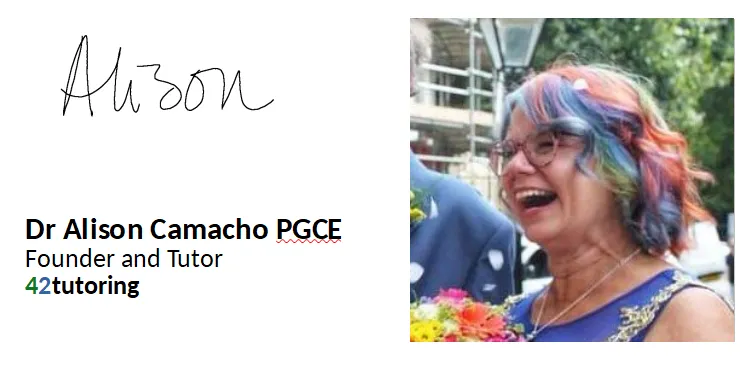
“Bespoke A level Physics tutoring is provided for every exam board. 42tutoring is committed to providing whatever your child needs to succeed in their A level Physics exams. You won't find more enthusiastic Physics tutors anywhere!”
This site is not associated with Facebook in any way. By opting in for the free class, you agree to be contacted about by phone and email about your enquiry. You can unsubscribe at any time.