Ultimate A level Results Day Guide 2026
The Ultimate Guide to A-Level Results Day 2026
Your Complete Guide to Results Day, UCAS, Clearing and Reviews of Marking
This guide gives advice on what to do on results day – no matter what your A level results are. There is no guesswork here. The advice has been checked and double checked against current rules and regulations - so you don't have to. Clickable references are given at the end.
It is important to have a plan for what you will do in each circumstance, before the day – when you are not an emotional wreck – so you can approach any situation calmly and get the best possible outcome for you.
The information in this guide has been checked against the official 2026 guidance published by UCAS, the Joint Council for Qualifications, GOV.UK, the NHS and the relevant awarding organisations. Procedures can still vary between examination centres and universities, so always listen to advice and follow the instructions given by your school, college, examination centre and university.
Managing Stress on Results Day - Look after yourself!
Results Day will likely be emotional, even when the outcome is positive. Preparing in advance will make it easier to think clearly if events do not unfold exactly as expected.
Before Results Day, check that you know how and when your school or college will issue your results. Make sure you can sign in to your UCAS application, that your contact details are up to date and that your phone is charged and working. It is also sensible to have your UCAS Personal ID, offer details and university contact information available.
Talk through the possible outcomes with a parent, teacher or another trusted person before the day. Consider what you would do if your firm choice confirmed your place, if you were accepted by your insurance choice, if a decision were still pending, or if you needed to investigate Clearing. Having a backup plan does not mean that you expect things to go wrong. It means that you will be better prepared to make a good decision.
Try not to make major decisions while panicking or feeling overwhelmed. Take a short break, have something to eat and speak to someone you trust. You usually have more than a few minutes in which to consider your options, although university vacancies, accommodation and post-results deadlines mean that you should not delay unnecessarily.
In England, anyone who needs urgent mental-health support can call NHS 111 and select the mental-health option. If someone is in immediate danger or there is a serious risk to life, call 999 or go to A&E. Samaritans can also be contacted free, at any time, on 116 123. Please watch out for your friends.
Results Day, Key Dates for 2026
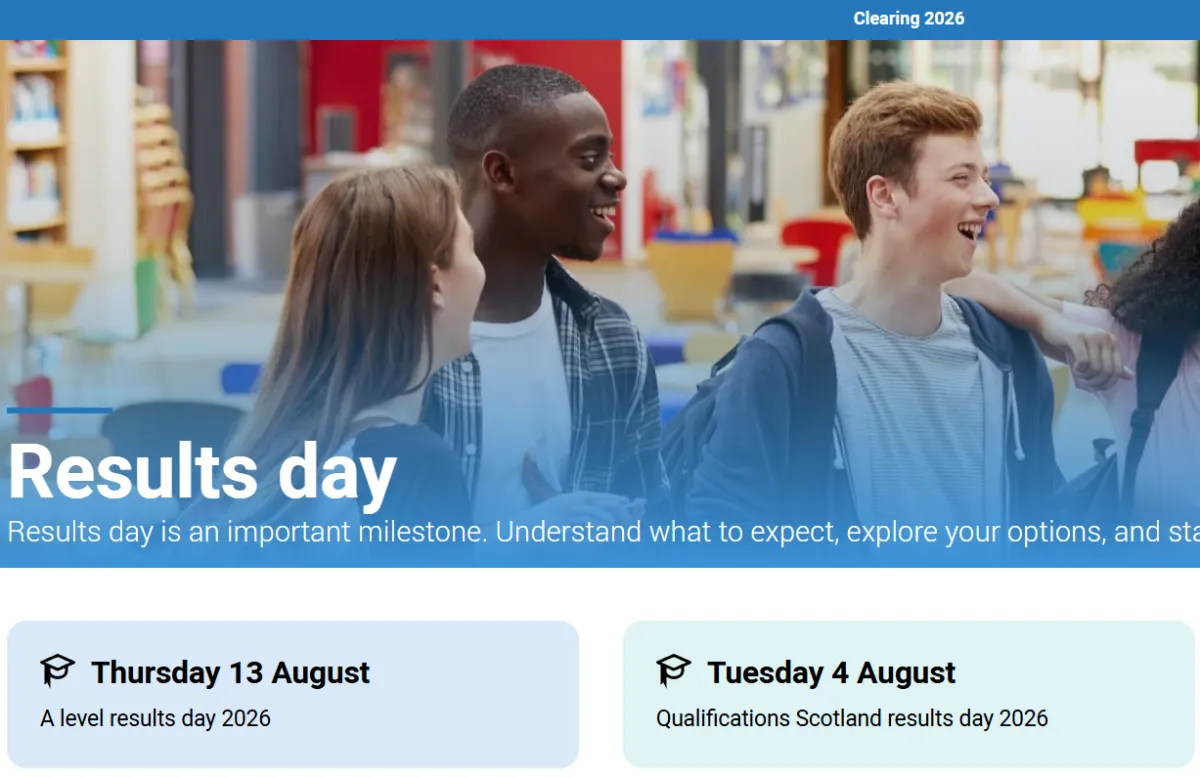
Qualifications Scotland Results Day is:
Tuesday 4 August 2026
UCAS applications are available from 09:00. From that time, Scottish applicants can check whether their application status has changed.
Eligible applicants can add a Clearing choice or reply to offers from 10:00.
A-Level Results Day is:
Thursday 13 August 2026
UCAS applications are available from 08:00. From this time, applicants can check whether their university application status has changed.
Eligible applicants can add a Clearing choice or reply to offers from 13:00.
The 2026 Clearing Period
Clearing opens on:
Thursday 2 July 2026
The final date to add a Clearing choice is:
Monday 19 October 2026
The final deadline for a new 2026-entry UCAS application is 18:00 on 24 September 2026.
Clearing therefore continues well beyond Results Day. You do not have to accept the first course you find simply because you are worried that all opportunities will disappear immediately. However, places on popular courses and in university accommodation can fill quickly, so investigate suitable options promptly.
What You Will See in Your UCAS Application
Your UCAS application shows decisions made by your universities or colleges. It is not normally where you obtain the full details of your examination marks.
You should collect or receive your actual results from your school, college or examination centre using the arrangements they have given you. UCAS receives many qualification results directly from awarding organisations and passes them to universities, but this does not apply to every qualification.
University decisions may not all appear at exactly the same time. A university may still be processing results, considering applicants who narrowly missed an offer or waiting for information that it has not yet received.
Read the complete wording shown in your application rather than relying only on an email notification or a brief status message.
Understanding Your UCAS Application Status
Your Place Is Confirmed
If your firm choice has become unconditional, your place has been confirmed. Congratulations.
You do not normally need to accept the place again in UCAS because you accepted it when you made it your firm choice. Follow the university’s instructions about enrolment, accommodation, student finance and any remaining administrative requirements.
Check your email carefully, including your junk/spam folder, because your university may send information about registration, accommodation, identity checks or course preparation.
Do not confuse a confirmed firm place with a changed course offer. A changed course offer may require a response within a specified period, as explained later in this guide.
Your Insurance Choice Is Confirmed
If your firm choice has not accepted you but your insurance choice has confirmed your place, your insurance choice becomes your confirmed university place.
You do not have to use Clearing simply because your firm choice was unsuccessful. First consider whether you are happy to attend your insurance university and study the course you selected there.
If you no longer want your insurance place and intend to use Clearing, read the section on declining a confirmed place before taking any action.
Waiting for Confirmation
A “waiting for confirmation” message means that UCAS is still waiting for the university or college to make or report its decision.
The university may be waiting for:
• a result that has not yet been received;
• evidence of another qualification;
• confirmation that a non-academic condition has been met;
• information connected with a DBS, occupational-health or other course requirement;
• time to consider applicants who narrowly missed their offers.
Read any messages in your UCAS application and check whether the university has asked you to provide something. Do not send documents simply because the status has not changed unless UCAS or the university says that they are required.
Where requested information is missing, send it using the method specified by the university. Keep evidence of what you have sent. If you believe that every condition has been met and the position remains unclear, contact the university admissions team.
While you are still holding a conditional firm or insurance offer, you cannot simply add a Clearing choice. If you are considering giving up an outstanding offer to enter Clearing, speak to the university and UCAS before doing so.
Unsuccessful
If both your firm and insurance choices are unsuccessful and you do not hold another offer, you will normally be eligible to use Clearing.
On A-Level Results Day, eligible applicants can add a Clearing choice from 13:00 on 13 August 2026. Scottish applicants can do so from 10:00 on 4 August 2026.
An unsuccessful decision does not necessarily mean that you have no suitable university options. You may find the same or a related course through Clearing, but you should still research the course carefully rather than selecting it purely because it is available.
You Have Been Offered a Different Course
A university may offer you a changed course if it cannot confirm the course originally selected but is prepared to offer an alternative.
The change could involve:
• a different course;
• a foundation year;
• a different start date;
• a different point of entry;
• another campus or course arrangement.
Read the complete offer before accepting it. Check the course title, course content, professional accreditation, campus, duration, tuition fees and progression requirements. You should also investigate accommodation and student-finance implications.
Depending on the decisions made by your firm and insurance choices, you may be able to accept the changed course, decline it in favour of your insurance choice or wait for your insurance choice to make a decision.
Where UCAS asks you to respond to a changed course offer, you must normally reply within five days or you may lose the offer. The five-day rule applies to relevant changed course offers; it is not a general requirement to reaccept an ordinary confirmed firm place.
Clearing: Who Can Use It?
You may be able to use Clearing if:
• you did not receive any offers;
• you declined all your offers;
• you did not meet the conditions of your firm or insurance offers;
• you applied after 30 June;
• you are applying for university for the first time during Clearing;
• you hold a confirmed place that you have decided to decline.
Eligibility will be shown in your UCAS application. Before giving up an existing offer, make sure that you understand the consequences and have researched your alternatives.
How to Use Clearing Safely
Research Courses Before Calling
Use the UCAS search service and individual university websites to look for vacancies. A course appearing in a Clearing search does not necessarily mean that it will remain available or that the university will accept every applicant who meets the published grades.
Investigate the course as carefully as you investigated your original choices. Check:
• the modules and course structure;
• professional accreditation;
• entry requirements;
• campus and location;
• accommodation availability;
• tuition fees and other costs;
• placements or years abroad;
• graduate destinations;
• whether a foundation year leads automatically to the degree;
• any progression conditions.
Do not assume that a course with a similar title is identical to the course you originally selected.
Prepare Before Contacting Universities
Have the following information ready:
• your UCAS Personal ID;
• your Clearing number, if one is shown;
• your A-Level and GCSE results;
• the name and code of the course;
• your personal statement and reference information;
• details of relevant work experience or achievements;
• a charged phone and reliable internet access;
• access to your email;
• a pen or document in which to record names, instructions and deadlines.
Prepare questions about the course, university, accommodation, placements and any conditions attached to the proposed offer.
The university may want to speak directly to you rather than to a parent. UCAS cannot discuss all aspects of your application with another person unless you have provided the appropriate nominated access.
Contact the University
Contact the university before adding it as a Clearing choice. Give it your Personal ID, Clearing number and results, together with any other information requested.
Ask whether the university is giving you permission to add the course as your Clearing choice. Also ask:
• whether the offer has any remaining conditions;
• how long the offer will be held;
• which course code you must enter;
• whether the offer applies to a particular campus or start date;
• whether written confirmation will be sent;
• what accommodation remains available.
A helpful or encouraging telephone conversation is not necessarily a formal offer. Make sure that you understand exactly what the university has agreed.
Add the Clearing Choice
Only add a Clearing choice after the university has given you permission.
Go to the choices section of your UCAS application and select Add Clearing choice. Enter the exact university and course information you have been given.
You can add only one Clearing choice at a time. Adding the choice means that you are accepting the university’s offer. If the university confirms the place, it will appear as an acceptance in your application. If it does not confirm you, you will be able to add another choice.
Declining a Confirmed Place
If you hold an unconditional firm place that you no longer want, you may see the Decline my place option in your UCAS application.
Before using it, speak to an adviser at your school or college and investigate your other options. If you want to change course while remaining at the same university, contact that university first. Do not decline the place unless the university specifically tells you that this is necessary.
Using the button cancels your place and your contract with the university. It may also affect linked accommodation, scholarships or other arrangements. There is no automatic way to restore the place afterwards, and the university is not obliged to give it back to you.
Do not decline your confirmed place simply so that you can look at Clearing vacancies. You can research courses and speak to universities before cancelling your existing place.
Student Finance After Clearing or a Course Change
If your university, course or living arrangements change, you must update your student-finance application.
A change in UCAS does not automatically update Student Finance England. If your course has not started, you can normally make the change through your online student-finance account. Update the university, course, tuition fee and where you expect to live.
Student Finance England advises that changes can take approximately four weeks to approve, so make them as soon as possible. If the course has already started, the university or college may need to notify Student Finance England on your behalf.
The arrangements described above apply to Student Finance England. Students funded through Wales, Scotland or Northern Ireland should follow the guidance issued by their own funding body.
If Your Results Have Not Reached the University
UCAS receives many results directly from awarding organisations, but not every result is transferred automatically.
You may need to provide evidence yourself if you have:
• certain vocational or professional qualifications;
• an international qualification;
• a music, performance or specialist award;
• a qualification not included in the UCAS results service;
• a result which the university says it has not received.
Check the instructions from UCAS and the university before sending anything. Use the university’s specified method and include the information it asks for. Do not send important documents to several unrelated university email addresses, as this can delay the process.
Alternatives to Clearing
Asking to Defer Your Place
You can ask your university whether it will allow you to defer your confirmed place and begin the course in 2027.
Deferral is at the university’s discretion and is not available for every course. A university may agree, refuse or ask you to apply again. Usually, entry can be deferred by only one year.
Obtain the university’s decision in writing and check what will happen to accommodation and student finance. International applicants should also check any visa implications.
Taking a Gap Year and Reapplying
A gap year can provide time to gain experience, earn money, improve an application, travel, volunteer or reconsider course choices. However, it should have a purpose rather than being treated as a failure or an automatic solution.
Before deciding to reapply, check whether you would be competitive for your preferred courses with the grades you have achieved. Also investigate whether universities will expect additional admissions tests, new work experience or other evidence.
Degree Apprenticeships
A degree apprenticeship combines paid employment with training and study towards a degree or another higher-level qualification.
Apprentices are employees and receive a salary, holiday pay and employment rights. They do not pay tuition fees for their apprenticeship training. However, they still need to meet living, travel and other personal costs.
A degree apprenticeship is not simply a university course chosen through Clearing. It is a competitive job application, and employers may use application forms, tests, interviews and assessment centres. Vacancies have their own recruitment timetables and may not be available on Results Day.
Foundation Years
A foundation year is an additional preparatory year at the start of an undergraduate course. It may be suitable for students who did not meet the standard entry requirements, studied different Level 3 subjects, are returning to education or need additional preparation for the degree.
Check whether progression from the foundation year to the main degree is automatic or dependent on achieving a specified mark. You should also check the total course length, tuition fees, student-finance arrangements and whether any professional accreditation applies to the full course.
A foundation year is not the same as a foundation degree.
Foundation Degrees
A foundation degree is normally a separate Level 5 higher-education qualification. It is commonly completed over two years of full-time study and is often linked to a particular profession or employment sector.
Some students later complete a top-up course to gain a full honours degree, but progression is not necessarily automatic. Check the admission requirements, duration and cost of any top-up route before enrolling.
Access to Higher Education Diplomas
An Access to Higher Education Diploma is a Level 3 qualification intended primarily for people who do not have the traditional qualifications needed for university entry. It is often used by mature students or people returning to education.
It is generally a longer-term route rather than an immediate substitute for Clearing. Students should check that the particular Access Diploma is accepted by their intended university and course before enrolling.
Plan Something Enjoyable
Whatever your results, you have completed a demanding period of study and examinations. Plan something calm or enjoyable for later in the day, whether that is a meal with friends, a walk, a film or simply some quiet time away from phones and university websites.
Results Day is important, but it does not define your ability, your future or the value of the work you have done. A confirmed university place is one possible next step, not the only possible route to a successful career.
Appendix: Reviews of Results, Reviews of Marking and Access to Scripts
The Correct Terminology
People often use the word “re-mark,” but this is not the official name of the process and it can give the wrong impression.
The principal post-results services are:
• access to scripts;
• a clerical re-check;
• a review of marking;
• a priority review of marking;
• a review of moderation;
• an appeal following the appropriate earlier process.
A review of marking is not a completely fresh marking of the paper. A reviewer checks whether the original marking applied the mark scheme correctly and changes the mark only where a marking error is identified.
Do Not Decide from the Grade Alone
Being close to a grade boundary tells you how many additional marks would be required to reach the grade above. It does not prove that those marks were wrongly withheld.
Before requesting a review, obtain as much of the following information as possible:
• the mark for each paper or component;
• the overall qualification mark;
• the published grade boundaries;
• a copy of the marked script, where available in time;
• advice from a teacher who understands the subject and mark scheme;
• the distance from the grade above;
• the distance from the grade below;
• the consequences of a mark or grade going down;
• any deadline set by a university.
A student who is one mark below a boundary may have no credible marking error. Another student who is several marks away may have a clear uncredited response. The number of marks from a boundary should therefore be considered alongside the evidence in the script.
Physics and Maths Papers Can Contain Marking Errors
It is not accurate to dismiss reviews of marking in Physics or Maths on the basis that every answer is simply right or wrong.
These subjects can include:
• method marks;
• error-carried-forward marks;
• alternative valid approaches;
• explanations and written reasoning;
• judgements about whether sufficient working has been shown;
• diagrams and graphical work;
• decisions involving units or significant figures;
• administrative or transcription errors.
JCQ states that a marking error can involve an administrative mistake, failure to apply the mark scheme to a right-or-wrong answer or an unreasonable exercise of academic judgement. A decision should therefore be based on the individual paper, not on a general assumption about the subject.
Access to Scripts
Your examination centre may be able to request a copy of your marked script before deciding whether to request a review of marking.
A teacher can use the script to check whether:
• every response appears to have been marked;
• marks have been transferred and totalled correctly;
• a valid method or explanation may not have received the appropriate credit;
• there is a plausible reason to request a review;
• the review should target a particular component.
Written permission is required before a centre obtains and uses a candidate’s script. Permission must be sought after the candidate has received the result.
Awarding organisations have their own arrangements for obtaining scripts, and timing is particularly important where a university place depends on a priority review. Ask your school or college immediately about the relevant board’s process.
Service 1: Clerical Re-check
A clerical re-check verifies:
• that all parts of the script were marked;
• that the marks were totalled correctly;
• that the marks were recorded correctly.
It does not reconsider the examiner’s academic judgement or conduct a full review of how the mark scheme was applied.
For the June 2026 examination series, the awarding organisation must receive the request by:
24 September 2026
The target completion time is within:
10 calendar days of the awarding organisation receiving the request
Written candidate consent is required because the mark and subject grade can go down as well as up.
Service 2: Review of Marking
A review of marking includes the clerical checks and a review of the original marking to determine whether the mark scheme was applied correctly.
The reviewer does not mark the entire paper again from the beginning. The reviewer corrects errors identified in the original marking.
For the June 2026 examination series, the awarding organisation must receive the request by:
24 September 2026
The target completion time is within:
20 calendar days of the awarding organisation receiving the request
Written candidate consent is required.
Priority Service 2: Priority Review of Marking
A priority review of marking is available for externally assessed A-Level components and certain Level 3 vocational qualifications. It is intended particularly for cases in which a university or college place may depend on the outcome.
For the June 2026 examination series, the awarding organisation must receive a request for an A-Level priority review by:
20 August 2026
This is only seven days after A-Level Results Day.
The target completion time is within:
15 calendar days of the awarding organisation receiving the request
Written candidate consent is required.
If your university place depends on the outcome, contact the university immediately. Tell it that a priority review has been requested and ask whether it will hold your place open. Obtain any deadline or agreement in writing where possible.
The awarding organisation does not tell the university merely because a review has been requested. It will, however, notify UCAS of a resulting grade change.
Review of Moderation
A review of moderation applies to the process used to moderate internally assessed work, such as coursework or non-examination assessment. It is not normally an individual student’s route for challenging one examination paper.
The review considers whether the original moderation applied the assessment criteria fairly, reliably and consistently. It is not a completely new moderation of the work.
A review of moderation is normally requested by the centre and may affect the marks of a group of students. It is not available where the awarding organisation accepted the centre’s marks without changing them.
For the June 2026 series, the deadline is:
24 September 2026
The target completion period can be up to 35 calendar days after the reviewer receives the original sample of work. JCQ warns that reviews of moderation may not be completed in time to meet an individual university’s deadline.
Marks and Grades Can Go Down
A review can result in:
• a higher mark
• a lower mark
• no change
For individual clerical re-checks and reviews of marking, the overall subject grade can go up, go down or remain the same. Because of this risk, written candidate consent is strictly mandatory before a school or college can submit these requests on your behalf.
In contrast, written candidate consent is not required for a Review of Moderation. While individual student marks can be lowered as part of a wider centre moderation adjustment, official JCQ regulations dictate that an individual candidate's published subject grade will not be lowered during the exam series concerned.
Before agreeing to a review, check not only how close you are to the grade above but also how close you are to the grade below. There is no general protection that prevents a mark or grade from being reduced.
Fees
Awarding organisations set their own fees for clerical re-checks, reviews of marking and related services. Schools and examination centres may also have their own arrangements for collecting those fees.
The circumstances in which a fee is waived or refunded vary between awarding organisations and services. Do not assume that every mark increase produces a refund.
Before consenting, ask your school, college or examination centre:
• which service is being requested;
• which paper or component is included;
• how much it will cost;
• whether the centre charges an administration fee;
• under what circumstances the fee will be refunded;
• whether more than one component should be considered.
How to Request a Service
Candidates entered through a school, college or examination centre do not normally apply directly to the awarding organisation.
Speak to your examination officer or the person responsible for results at your centre. The centre must submit the request and hold your written consent where required.
Schools and colleges may set their own internal deadlines before the official awarding-organisation deadlines. Act immediately if you are considering a priority review, because the official deadline is only one week after A-Level Results Day.
Private candidates should contact the examination centre through which they made their entry.
Contacting Your University
If a university place depends on a possible grade change, contact the admissions team as soon as possible.
Explain:
• which result is being reviewed;
• whether a priority review has been requested;
• the date on which the request was submitted;
• the awarding organisation’s target completion time;
• any evidence or reference number supplied by your examination centre.
Ask whether the university will keep the place available and the final date by which it will accept a changed result. A university is not required to hold a place indefinitely, and a successful review does not automatically restore a place that has already been withdrawn or filled.
Appeals
An appeal is not the first stage of checking an examination result. It normally follows a clerical re-check, review of marking or other relevant awarding-organisation process.
Appeals are subject to specific grounds and procedures. They are not an opportunity to request repeated fresh marking simply because the candidate remains disappointed with the outcome.
If you believe that there is a basis for an appeal after the review process has been completed, speak to your school or examination centre and consult the current guidance issued by the awarding organisation and JCQ.
2026 References
1. UCAS — Check the availability of UCAS applications
This contains the confirmed 2026 opening times for UCAS applications on Scottish and A-Level Results Days.
2. UCAS — A-Level Results Day
https://www.ucas.com/applying/after-you-apply/clearing-and-results-day/results-day
This is the main UCAS Results Day guidance page.
3. UCAS — Dates and deadlines for university applications
https://www.ucas.com/undergraduate/applying-university/dates-and-deadlines-uni-applications
This contains the 2026 application and Clearing dates.
4. UCAS — What your application status means
This explains confirmed places, pending decisions and changed course offers.
5. UCAS — Applying directly to Clearing
https://www.ucas.com/applying/after-you-apply/clearing-and-results-day/applying-directly-to-clearing
This confirms that Clearing runs from 2 July to 19 October 2026 and explains who can use it.
6. UCAS — How do I add a Clearing choice?
https://www.ucas.com/faqs/how-do-i-add-clearing-choice
7. UCAS — Declining your firm place
https://www.ucas.com/node/353256
This is the current live UCAS page explaining the consequences of using “Decline my place.”
8. UCAS — Deferred entry
This explains that deferral is normally for one year and is at the university’s discretion.
9. JCQ — Post-results services for the June 2026 examination series
https://www.jcq.org.uk/exam-results-data/post-results/
This is the principal official source for access to scripts, clerical re-checks, reviews of marking, priority reviews, moderation reviews and appeals.
10. Student Finance England — How-to guide
https://www.gov.uk/guidance/student-finance-england-how-to-guide
This page was updated in January 2026 to include information for the 2026–27 academic year.
11. GOV.UK — Guidance for students going through Clearing
https://www.gov.uk/guidance/guidance-for-students-going-through-clearing
This explains how to update a student-finance application after changing university, course or living arrangements through Clearing.
12. HM Government — Apprentice pay and future salary
https://www.apprenticeships.gov.uk/apprentices/apprentice-pay-and-future-salary
This confirms that apprentices are employees, receive a salary and holiday pay, and do not pay tuition fees for their apprenticeship training.
13. GOV.UK — Mature students: university and funding
https://www.gov.uk/mature-student-university-funding
This includes official information about Access to Higher Education courses and alternative university entry qualifications.
14. NHS England — NHS 111
https://www.england.nhs.uk/urgent-emergency-care/nhs-111/
This confirms that NHS 111 provides 24-hour support for urgent physical and mental-health needs.
15. NHS England — NHS 111 mental-health crisis support
https://www.england.nhs.uk/2024/08/nhs-111-offering-crisis-mental-health-support-for-the-first-time/
This specifically confirms that people in England can call 111 and select the mental-health option to reach trained mental-health support.