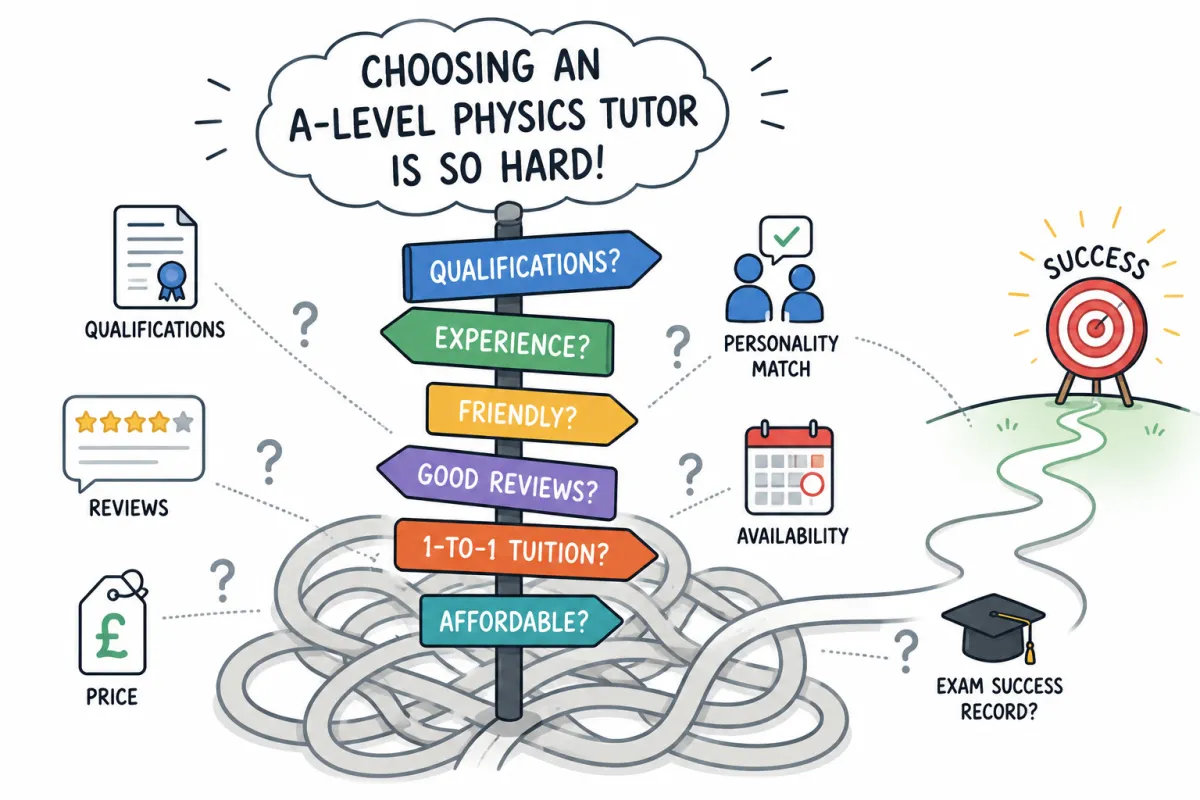
Why choosing a tutor is so hard
Why Choosing an A-Level Physics Tutor Is So Hard
If you've started looking for an A-Level Physics tutor, you've probably discovered that they all sound remarkably similar. They all know Physics. They all have impressive qualifications. Some are qualified teachers, others are studying Physics or Engineering at prestigious universities, and many have excellent reviews from previous students. Almost all promise to improve confidence, explain difficult topics and teach exam techniques to prepare students for exams. So how do you choose?
The honest answer is that it's incredibly difficult, and not because there aren't lots of good tutors. The problem is that, as a parent, you're trying to choose something that is almost impossible to evaluate before you've bought it. In fact, it's often difficult to judge even after several months of tuition. You're not sitting in the lessons, you don't see every piece of work your child completes, and you probably don't know exactly why they're losing marks in the first place. Your son or daughter usually can’t figure it out either!

The only evidence available, is what your child tells you, the occasional school assessment, school reports, and perhaps some feedback from the tutor, if they provide it. Choosing a Physics tutor therefore requires an enormous amount of trust.

Most parents naturally assume that Physics tuition is largely about explaining Physics more clearly, so the student’s understanding improves. Sometimes that is exactly what's needed. If a student has genuine gaps in their understanding of the subject, then almost any knowledgeable Physics tutor can make a significant difference. Explaining concepts in a different way, working through examples and answering questions, are all extremely valuable.

However, many of the students who come to us, aren't in that situation at all. They're bright students who work hard. They complete their homework, revise conscientiously and understand what their teachers explain in class. Despite all of that effort, their grades stubbornly refuse to improve. That's because understanding Physics and achieving high marks in A-Level Physics exams are related, but they are not exactly the same skill.
One of the biggest challenges with traditional tuition is that it often starts with a perfectly sensible question: "What would you like help with this week?" Unfortunately, students usually identify the topic they found difficult, rather than the reason they lost marks. Those two things are not necessarily the same. A student might say they're struggling with electricity, when the real problem is interpreting long exam questions, selecting the correct equation, structuring six-mark answers, understanding command words or communicating clearly enough to earn all of the available marks. Spending another hour explaining momentum may improve their understanding, but it may not solve the problem that's actually preventing them from improving their grade.

This is where diagnosis becomes so important. A tutor may have a Physics degree, be studying at Oxford, Cambridge or Imperial, hold a PhD or have many years of teaching experience. Those qualifications tell you that they understand Physics, which is obviously essential. They don't automatically tell you that they can identify why a particular student is consistently dropping marks. That's a different skill altogether, and it's one that parents understandably find very difficult to assess before committing to months of tuition.
One student, Michaela, illustrates this perfectly. She joined one of my Easter revision courses while working at a solid B grade. She certainly wasn't lazy. In fact, she was doing exactly what she'd been told to do. She completed paper after paper, marked them carefully and worked incredibly hard, yet her grade simply wasn't moving. She signed up for the course because nothing was working to move her grade.
During the course we spent a great deal of time looking at exam techniques, particularly the structure of answers. One area we covered was how command words provide a framework for six-mark questions. Michaela learned to follow all the instructions so as to address every part of the question. She “couldn’t believe how straight-forward it was once she’d been shown how”.
After the Easter course it tooke her two more weeks of practice using the techniques she’d learned to mover from a B grade to an A*. Michaela was exceptionally hardworking, and she deserves enormous credit for the effort she put in, but her story demonstrates an important point. She hadn’t suddenly become much better at Physics. Her improvement came from identifying, and working on, the real obstacle that has been limiting progress all along.
This is one of the reasons I believe parents should think carefully about the type of tuition they're choosing rather than simply whether they're choosing the "best" tutor. Traditional one-to-one tuition can be excellent, particularly when a student genuinely has gaps in their understanding of the subject. However, the model often relies on the student deciding what they need help with each week. If the student correctly identifies the problem, that's ideal. If they don't, it's entirely possible to spend months working hard without ever addressing the underlying issue. That isn't because the tutor lacks knowledge or because the student isn't trying hard. It's because neither of them has started by diagnosing exactly why marks are being lost.

Students aren't trained to analyse their own exam performance in that way. In fact, that's one of the reasons they're looking for help. A more effective approach is to begin by identifying the bottlenecks that are limiting progress and then building a plan around those findings. For one student that might mean strengthening fundamental Physics knowledge. For another it might involve problem-solving skills, interpreting exam questions, command words, mathematical techniques, practical questions or developing a more effective exam strategy. The solution should fit the student rather than expecting every student to fit the same model of tuition.
So what should parents actually look for when choosing Physics tuition? Rather than focusing solely on qualifications or believing vague statements that the tutor will “improve their grade and confidence and motivation”, I'd encourage you to ask a few questions that often don't get asked.

How will you work out why my child is losing marks?
How do you decide what to teach each week?
Do you regularly mark students' work?
How will I know whether the tuition is working?
Do you guarantee an improvement in grade?
What happens if you discover that the problem isn't missing Physics knowledge at all?
None of these questions has one universally correct answer, but the discussion they generate will usually tell you much more about the quality of the tuition, than a long list of qualifications or glowing testimonials.
Every Physics tutor should understand Physics. That's the starting point, not the finishing line. The more important question is whether they can identify what's preventing your child from demonstrating the Physics they already know. The challenge for parents is that none of those things is obvious from a website or a tutor's CV.
If there's one question I'd encourage every parent to ask before committing to Physics tuition, it's this:
"How will you work out what my child actually needs?"
The answer to that question may tell you far more about the quality of the tuition than any list of qualifications ever could.